
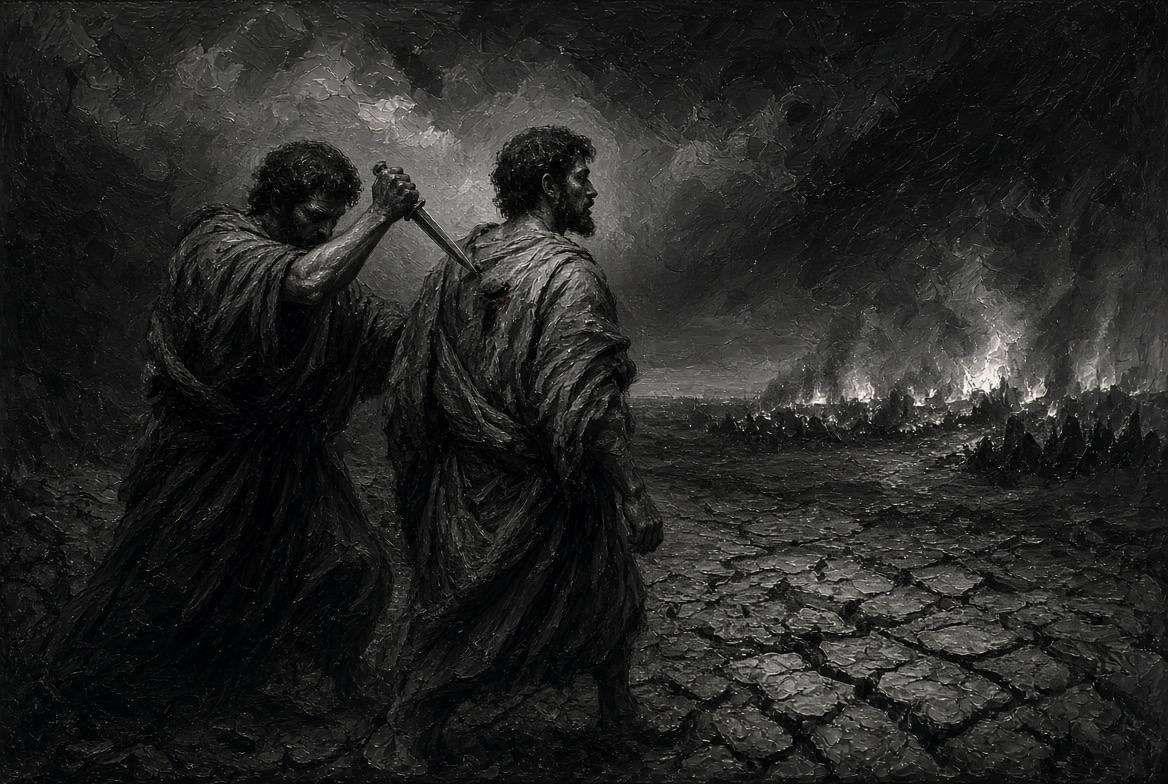
War destroys cities and lives, but betrayal destroys something far deeper and more delicate — trust, loyalty, and spiritual bonds. While war is visible and its blows can be felt, betrayal is hidden and treacherous, and that is precisely why it inflicts the deepest pain. War strikes the body and the structures of society, but betrayal always strikes the heart, leaving scars on the soul that never heal.
Betrayal takes many forms and manifests itself on different levels. It can be personal — when trust is broken in friendship, love, or family, leaving a person with a profound sense of loneliness and loss. It can be spiritual — when a person betrays their own principles and conscience, losing inner harmony and the foundation upon which they stand. It can be societal — when personal interests are placed above the common good, destroying solidarity and dividing people. And finally, it can be a betrayal of one's country — when, for personal gain or under the influence of foreign powers, individuals turn against their own nation, undermining its security and sovereignty. Every form of betrayal brings destruction, and the greater the trust, the more devastating the blow and the deeper the consequences.
The most terrifying thing about betrayal is that it leaves behind not only pain but also emptiness. Personal betrayal inflicts a wound upon the soul, often accompanied by the loss of the ability to trust. Spiritual betrayal leads to inner devastation, when a person ceases to believe in their own convictions and loses a sense of purpose. Betrayal within society breeds cynicism, distrust, and indifference, while betrayal of one's country undermines the foundations of government and destroys people's faith in their own future. Where betrayal becomes the norm, society loses its strength, and the state loses its stability.
Yet human history also reveals the opposite — extraordinary examples of loyalty that have inspired and saved entire nations. In the Gospel, we witness the tragedy of Judas Iscariot, who betrayed his Teacher, and the strength of Christ, who did not curse but accepted the cross for the salvation of the world. We know of Brutus's betrayal of Julius Caesar, which became a symbol of political treachery and the destruction of trust at the very heart of power. But alongside these examples stand others: Charles de Gaulle's loyalty to his country during its darkest years; the loyalty of soldiers who, despite fear and hardship, refused to abandon their comrades; and the loyalty of those willing to sacrifice themselves for truth and love.
Betrayal is worse than war because it corrodes the very foundation of human life — trust. Without trust, it is impossible to build a family, a society, or a state. Without trust, a person is left alone, and a nation fractures into hostile factions. That is why betrayal is not merely a personal tragedy but a threat to society as a whole.
I know that sooner or later, each of us faces a choice: to remain loyal or to betray. And I choose loyalty. Loyalty to my principles and my conscience, loyalty to my loved ones and friends, loyalty to truth and to God. I am convinced that loyalty is the force that keeps the world from falling into complete destruction. Loyalty is the foundation upon which relationships, families, societies, and entire nations are built.
I believe that betrayal can only be overcome by recognizing its destructive power and strengthening loyalty as one of the highest human values. May each of us preserve this loyalty within ourselves — loyalty to truth, to our conscience, to our family, and to our nation.
With faith in God, truth and the future.
I am honoured!
Andrey Gmyrin
